Helicobacter pylori Infection Explained: One Hidden Bacterium Could Be Causing Your Ulcers and Acidity
If you’ve been struggling with recurring acidity, heartburn, stomach pain, bloating, or ulcers, the problem may not simply be your diet. A tiny spiral-shaped bacterium called Helicobacter pylori (H. pylori) could be the hidden cause.
H. pylori is one of the most common bacterial infections worldwide, affecting millions of people. Many individuals carry the bacterium without knowing it because it often causes no symptoms. However, in some people, it damages the stomach lining, leading to gastritis, peptic ulcers, and, in rare cases, stomach cancer.
The good news is that H. pylori infection can usually be diagnosed accurately and treated effectively with medication.
In this guide, we’ll explain what H. pylori is, how it spreads, its symptoms, diagnosis, treatment options, possible complications, and how you can protect your digestive health.
What Is Helicobacter pylori?
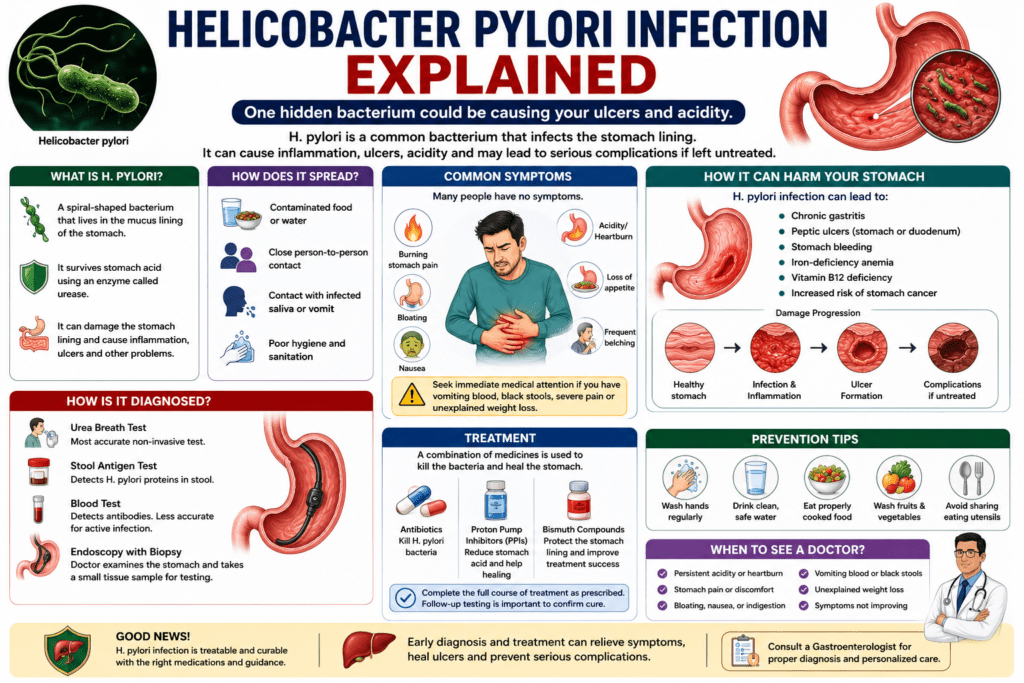
Helicobacter pylori, commonly known as H. pylori, is a spiral-shaped bacterium that lives in the protective mucus lining of the stomach.
Unlike many bacteria, H. pylori survives in the stomach’s highly acidic environment by producing an enzyme called urease, which neutralizes stomach acid around it. This allows the bacterium to colonize the stomach lining and persist for years if left untreated.
Although many infected people remain symptom-free, the bacterium can trigger inflammation and damage the stomach lining over time.
How Common Is H. pylori Infection?
H. pylori is one of the most widespread bacterial infections globally.
Many people become infected during childhood and may carry the bacteria for decades without realizing it.
The infection is more common in areas with:
- Overcrowded living conditions
- Limited access to clean water
- Poor sanitation
- Lower socioeconomic conditions
However, anyone can become infected, regardless of age or lifestyle.
How Does H. pylori Spread?
Researchers believe H. pylori spreads through:
- Contaminated food
- Contaminated water
- Close person-to-person contact
- Contact with infected saliva
- Poor hand hygiene
Good hygiene practices can help reduce the risk of infection.
Symptoms of H. pylori Infection
Many people with H. pylori infection have no symptoms.
When symptoms develop, they often result from inflammation or ulcers.
Common symptoms include:
- Burning stomach pain
- Frequent acidity
- Heartburn
- Bloating
- Excessive burping
- Nausea
- Loss of appetite
- Feeling full quickly
- Indigestion
- Upper abdominal discomfort
Symptoms often become worse when the stomach is empty.
Warning Signs That Require Immediate Medical Attention
Seek urgent medical care if you experience:
- Vomiting blood
- Black, tarry stools
- Severe abdominal pain
- Difficulty swallowing
- Persistent vomiting
- Unexplained weight loss
- Severe weakness or dizziness
These symptoms may indicate bleeding ulcers or other serious complications.
How Does H. pylori Cause Ulcers?
Normally, the stomach lining is protected from acid by a layer of mucus.
H. pylori weakens this protective barrier by:
- Damaging stomach cells
- Triggering chronic inflammation
- Increasing vulnerability to stomach acid
Over time, acid and digestive juices can erode the stomach lining, leading to ulcers.
Conditions Linked to H. pylori Infection
If untreated, H. pylori may contribute to several digestive disorders.
Chronic Gastritis
Persistent inflammation of the stomach lining is one of the most common effects.
Peptic Ulcers
Ulcers may develop in:
- The stomach
- The duodenum (first part of the small intestine)
Symptoms often include burning abdominal pain and indigestion.
Stomach Bleeding
Bleeding ulcers can lead to:
- Black stool (melena)
- Vomiting blood
- Anemia
This is a medical emergency.
Iron-Deficiency Anemia
Chronic bleeding from ulcers may gradually reduce iron levels.
Vitamin B12 Deficiency
Long-standing H. pylori infection may interfere with vitamin B12 absorption in some people.
Stomach Cancer
Although uncommon, chronic H. pylori infection increases the risk of gastric cancer over many years.
Early diagnosis and treatment help reduce this risk.
Who Is at Higher Risk?
Anyone can develop H. pylori infection, but the risk is higher if you:
- Live in crowded households
- Have poor sanitation
- Share food or utensils frequently
- Drink contaminated water
- Have a family history of H. pylori infection
- Live in regions where the infection is common
How Is H. pylori Diagnosed?
Several reliable tests are available.
Urea Breath Test
This is one of the most accurate, non-invasive tests.
You swallow a special solution, and your breath is analyzed for evidence of H. pylori.
Stool Antigen Test
A stool sample is tested for H. pylori proteins.
This test is also commonly used to confirm that treatment has been successful.
Blood Test
Blood tests detect antibodies against H. pylori.
However, they cannot reliably distinguish between a current and a past infection, so they are less commonly used for diagnosis.
Upper GI Endoscopy
During endoscopy, a gastroenterologist examines the esophagus, stomach, and duodenum using a flexible camera.
Small tissue samples (biopsies) may be taken to test for H. pylori and assess stomach damage.
Endoscopy is often recommended for people with warning signs such as bleeding, weight loss, or persistent symptoms.
How Is H. pylori Treated?
Treatment aims to eliminate the bacteria, heal the stomach lining, and prevent complications.
Antibiotics
A combination of antibiotics is prescribed to kill the bacteria.
Completing the full course is essential, even if symptoms improve.
Proton Pump Inhibitors (PPIs)
These medications reduce stomach acid, allowing ulcers and inflammation to heal more effectively.
Bismuth-Based Therapy
In some cases, bismuth-containing medications are included to improve treatment success.
Follow-Up Testing
Doctors often recommend repeat testing—usually with a urea breath test or stool antigen test—to confirm that the infection has been eradicated.
Foods That May Help During Recovery
Although diet alone cannot cure H. pylori infection, healthy eating can support healing.
Choose:
- Fresh fruits
- Vegetables
- Whole grains
- Yogurt with live cultures (if tolerated)
- Lean proteins
- Adequate water
Limit:
- Spicy foods if they worsen symptoms
- Fried foods
- Excess caffeine
- Alcohol
- Smoking
Can H. pylori Be Prevented?
There is currently no vaccine against H. pylori.
However, you can reduce your risk by:
- Washing hands with soap before meals and after using the restroom
- Drinking safe, clean water
- Eating properly cooked food
- Washing fruits and vegetables thoroughly
- Avoiding sharing eating utensils when someone is ill
- Practicing good food hygiene
Common Myths About H. pylori
Myth: H. pylori infection always causes symptoms.
Fact: Many people have no symptoms for years.
Myth: Antacids cure H. pylori.
Fact: Antacids relieve symptoms but do not eliminate the bacteria.
Myth: Spicy food causes H. pylori.
Fact: Spicy foods may worsen discomfort but do not cause the infection.
Myth: Once treated, H. pylori always comes back.
Fact: Most people are successfully cured with the appropriate treatment regimen, though reinfection is possible.
Frequently Asked Questions
Can H. pylori go away without treatment?
In most cases, no. The infection usually persists unless treated with appropriate antibiotics.
Is H. pylori contagious?
Yes. It can spread through contaminated food, water, or close contact with infected individuals.
Can H. pylori cause acid reflux?
H. pylori is primarily associated with gastritis and ulcers. Some people experience acid-related symptoms, but reflux has many possible causes.
How long does treatment take?
Most treatment courses last 10–14 days, depending on the prescribed regimen.
Can children get H. pylori?
Yes. Many infections are acquired during childhood, although symptoms may not appear until later.
When Should You See a Gastroenterologist?
Consult a gastroenterologist if you experience:
- Persistent acidity or heartburn
- Recurrent stomach pain
- Frequent bloating or indigestion
- Black stools or vomiting blood
- Unexplained weight loss
- Difficulty swallowing
- Symptoms that do not improve with treatment
- A history of stomach ulcers
Timely diagnosis can prevent serious complications and improve your quality of life.
Final Thoughts
Helicobacter pylori is a common but often overlooked bacterial infection that can quietly damage the stomach lining for years. While many people never develop symptoms, others experience recurring acidity, gastritis, indigestion, or painful ulcers that significantly affect daily life.
The encouraging news is that H. pylori infection is usually treatable and curable. Modern diagnostic tests such as the urea breath test, stool antigen test, and endoscopy help identify the infection accurately, while antibiotic therapy combined with acid-reducing medication can successfully eliminate the bacteria in most cases.
If you’ve been dealing with persistent acidity, unexplained stomach pain, recurrent ulcers, or digestive discomfort, don’t rely solely on over-the-counter remedies. Consult a gastroenterologist for a proper evaluation. Early diagnosis and treatment can relieve symptoms, heal the stomach lining, and reduce the risk of long-term complications.
Your stomach shouldn’t hurt every day. Identifying the hidden cause could be the first step toward lasting digestive health.